


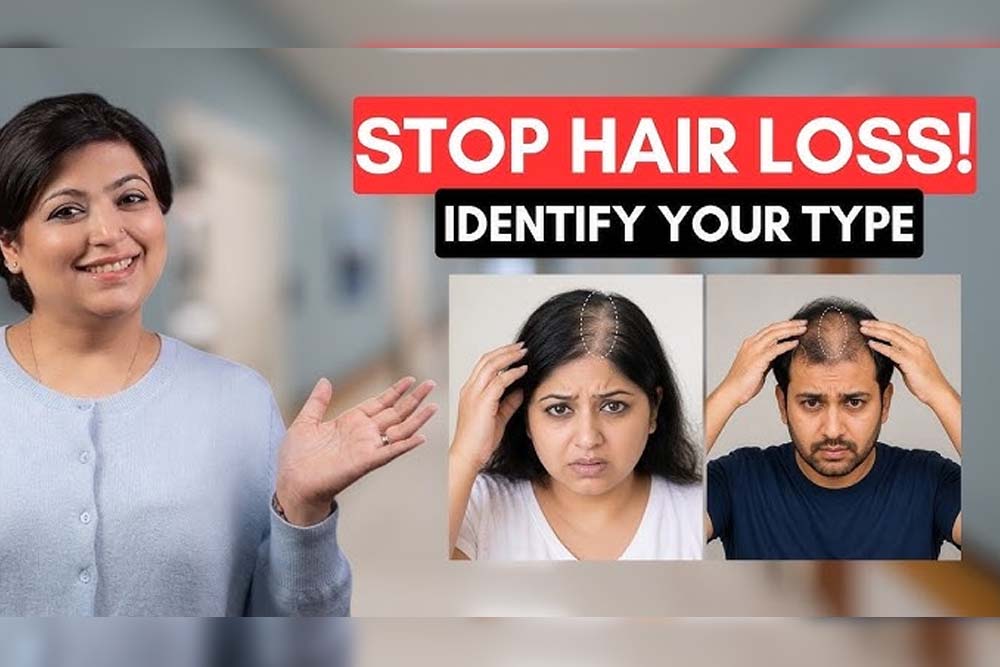
6 Common Types of Hair Loss: How to Tell Them Apart and What Actually Helps
Not all hair fall is the same, and treating the wrong type with the wrong approach wastes months of effort. If you've been dealing with any kind of hair loss and searching for the right
hair loss
treatment in Delhi
, understanding exactly which type you're facing changes everything about what actually works.
1. Female Pattern Hair Loss
This is genuinely one of the most common hair concerns, yet most women don't realise it's a distinct, identifiable condition. It presents as hair gradually becoming thinner, weaker, fine, brittle, and frizzy. The parting widens over time, the ponytail gets visibly thinner, and hair loses its bounce, going flat and lifeless. A lot of people mistake this for dryness and blame their salon products, but the reality is different hair strands themselves have simply reduced in diameter, becoming so thin they turn brittle and frizzy toward the ends.
A key diagnostic clue here you might never actually notice hair falling out. Instead, you'll simply realise you have less hair than you did a few years ago. This is hormonal hair thinning, not a vitamin deficiency, which is exactly why vitamin supplements alone typically deliver only 15-20% improvement before plateauing.
It's also worth clearing up a common misconception while heavy hair colouring, keratin treatments, and smoothening can contribute somewhat (perhaps 15-20% of the problem), they're not the primary cause. The real driver is usually hormonal PCOD, general hormonal imbalance even without PCOD, post-pregnancy hormonal shifts, or perimenopausal changes after 40.
Sign | What It Means |
Widening parting, thinner ponytail | Hormonal hair thinning, not dryness |
No visible shedding but less hair overall | Classic sign of female pattern hair loss |
Only 15-20% improvement with vitamins | Confirms hormonal rather than nutritional cause |
For treatment, minoxidil is a well-known option, though it comes with a catch stopping it causes the hair it helped regrow to fall out again, which is why non-minoxidil serums with stem cell technology, Redensyl, Procapil, or Pixel are often preferred instead, ideally applied after derma rolling to boost scalp blood supply. Low-level laser therapy (LLLT) via a laser cap, worn for just 10 minutes daily, is another genuinely effective, low-effort option.
For in-clinic treatment, exosomes are a particular favourite delivered via derma pen for a pain-free approach, they offer results considerably superior to older options like PRP, GFC, or QR678.
2. Telogen Effluvium
This type involves sudden, dramatic hair shedding, typically triggered by a stressful event roughly three months earlier. Look back, did you go through crash dieting, surgery, an illness like typhoid, dengue, COVID, or chikungunya, or childbirth around two to three months before the shedding started? That delay is characteristic of telogen effluvium.
The genuinely good news here is that this type usually stems from nutritional deficiency triggered by that stressful period, meaning supplements biotin, iron if deficient, Omega-3 often lead to real, complete recovery, unlike hormonal hair loss.
Trigger (2-3 months prior) | Leads to Telogen Effluvium |
Crash dieting | Yes |
Surgery or major illness (typhoid, dengue, COVID) | Yes |
Childbirth | Yes |
Significant stress event | Yes |
3. Male Pattern Baldness
This shows up as a receding hairline and gradually broadening forehead, or thinning at the crown, with hair on the sides thinning progressively too. Like female pattern hair loss, this is hormonally driven, and vitamins alone offer limited 15-20% improvement at best genuine treatment needs to happen at the clinic level.
At-home options include Procapil or Redensyl-based serums, minoxidil-based serums (if you're committed to lifelong use), and stem-cell based serums, ideally combined with derma rolling and a laser cap for better results. For more significant thinning, hair transplant becomes necessary, but for moderate cases, in-clinic treatments like exosomes, QR678, or the more budget-friendly GFC (Growth Factor Concentrate) all show genuinely good results.
4. Traction Alopecia
This occurs in both men and women, caused by constant pulling on hair typically from tight ponytails or tightly tied hair. It's particularly common in young girls who wear tight ponytails to school daily, and in men who tie their hair back tightly. The constant tension gradually thins hair along the pull points.
The first and most important step is changing the hairstyle itself. This stops progression. If caught early, hair can genuinely regrow. But if this pattern has persisted for years, the damage may be permanent, leaving hair transplant as the only remaining option.
Traction Alopecia Stage | Treatment Outcome |
Early, recently noticed | Hair can regrow after stopping the pulling habit |
Long-standing, years of tension | Damage may be permanent, hair transplant needed |
5. Alopecia Areata
This is a genuinely different category, an autoimmune condition where the body's own antibodies attack hair follicles, causing sudden, coin-shaped bald patches. Importantly, it's completely asymptomatic with no itching, burning, or irritation which is why people often only discover it when someone else points it out, like a hairdresser or family member.
A common myth worth debunking directly is that there's no "insect" or infection causing this. It's purely autoimmune. For one or two patches, treatment with vitamins and topical creams often works, and children in particular sometimes see spontaneous regrowth. There's a genuine link with Vitamin D deficiency too, so supplementing where deficient helps. The most reliable treatment for stubborn patches is intralesional injections directly into the affected area.
If patches are growing in size or number, that signals active, progressive disease, and this isn't something to wait out at home. It needs prompt consultation with a qualified dermatologist, since oral medications may be needed to stop the immune system from continuing to attack hair follicles.
6. Scarring (Cicatricial) Alopecia
This is also autoimmune, but genuinely more serious than alopecia areata. Unlike alopecia areata, where hair typically has a good chance of regrowing, scarring alopecia destroys the hair follicle itself permanently. Once the follicle is gone, no treatment can bring that hair back.
This is why immediate dermatologist consultation is essential: the goal becomes stopping progression through appropriate topical and oral medications that suppress the immune attack, preserving whatever follicles remain rather than trying to regrow what's already been destroyed. Once the disease stabilises, hair transplant remains the only option for restoring lost hair.
Hair Loss Type | Reversible? | Key Treatment Approach |
Female pattern hair loss | Manageable, not reversible | Non-minoxidil serums, exosomes, derma rolling |
Telogen effluvium | Yes, often fully | Nutritional supplements |
Male pattern baldness | Manageable, not reversible | Serums, exosomes, GFC, transplant if advanced |
Traction alopecia | Yes, if caught early | Change hairstyle immediately |
Alopecia areata | Often yes | Injections, oral medication if progressive |
Scarring alopecia | No, follicle destroyed | Immediate treatment to halt progression |
Getting the Right Diagnosis First
Identifying which of these six categories you're dealing with is genuinely the most important step before starting any treatment, since the wrong approach for the wrong type wastes time while the underlying issue continues. This kind of precise diagnosis is exactly what comes up in consultations at Dadu Medical Centre. If your hair loss doesn't fit neatly into an obvious pattern, or if patches are spreading, consulting a dermatologist in Delhi promptly can make a genuine difference in outcome, particularly for autoimmune types where early intervention matters significantly.
For anyone exploring a proper hair clinic in Delhi, understanding these distinct categories hormonal, nutritional, mechanical, or autoimmune makes that first consultation far more productive than describing symptoms generically.
Final Thoughts
Hair loss isn't a single condition with a single fix; six genuinely distinct categories exist, each with different causes and treatment approaches. Getting the diagnosis right, rather than assuming vitamins or a single serum will fix everything, is what actually determines whether your hair loss improves or continues unchecked.
Comments (0)
Loading comments...