


Hair Transplant Surgery In India
Best Hair Transplant Surgery In India
DMC Trichology® offers the most advanced effective and the best hair transplant surgery in India. Founded by India’s leading hair transplant surgeon, Dr. Nandini Dadu, we provide innovative and effective treatments with a patient-first approach. Our clinic, located in Vasant Vihar (South Delhi) and Rajouri Garden (West Delhi), offers comprehensive analysis and solutions for various hair loss problems.
Many people are now aware of hair transplantation and its effectiveness in hair restoration. This surgical technique aids in restoring natural hair growth and helps manage baldness. It is an elective procedure sought after by anyone suffering from stage 2 or beyond the grade of hair loss (alopecia) and unhappy with their appearance.
Hair transplantation is a safe and painless procedure performed under local anaesthesia at DMC Trichology Clinic, one of the best hair transplant clinics in Delhi, India. This aesthetic operation involves the transfer of healthy hair follicles from the areas of the scalp with dense, healthy hair growth to areas with sparse hair growth. The sites from where the hair follicles are harvested are called the donor sites while the areas where the hair follicles are implanted are called the recipient sites. Usually, the donor sites are the back or sides of the head. But in case of severe baldness, the hair grafts can also be taken from other body parts like the beard and chest.
Is Hair Transplant Right for Me?
The following facts must be considered when checking on candidacy for hair transplantation:
- Hair loss patterns are less predictable at a young age. Hair transplantation is generally performed on people over the age of 25 years.
- Men with the Norwood pattern of hair loss tend to respond best to hair transplantation.
- People with a high hair follicle density generally receive better coverage with hair transplantation.
- The area of balding is an important factor to consider for a hair transplant. FUE is most useful for treating hair loss at the front of the head.
- Men and women with permanent areas of hair loss caused by trauma or injuries like burns, surgery, scalds, or accidents can conceal the bald areas of their heads with transplanted hair.
- Grey hair can be extracted, implanted, and dyed for a more aesthetically pleasing appearance, with the option to dye the hair two weeks after the transplant.
- For any aesthetic surgery including a hair transplant, the candidates must be healthy and hold realistic expectations of the outcome of their surgery.
Hair transplantation is not a good option for:
- Women whose hair loss is spread throughout the scalp
- Grade 7 patients with poor donor area require consultation.
- Candidates who lack donor hair sites are required to remove hair for relocation.
- Candidates with a history of three previous hair transplants, experiencing temporary hair loss due to medication use or conditions like a thyroid disorder, and passing a thorough examination may also be eligible.
- People with dormant or weak hair follicles.
To determine your candidacy for a hair transplant surgery in India, book a visit with the hair transplant surgeon Dr. Nandini Dadu at DMC Trichology Clinic.
Methods of Hair Transplant
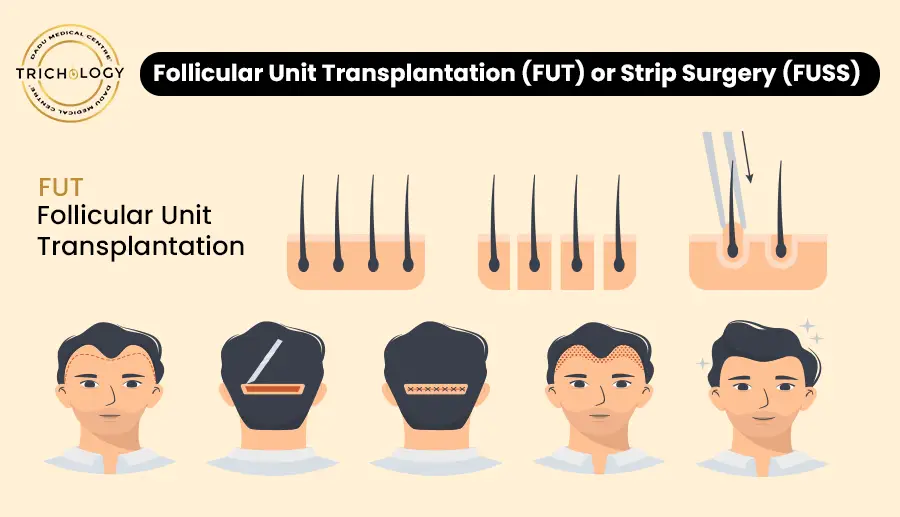
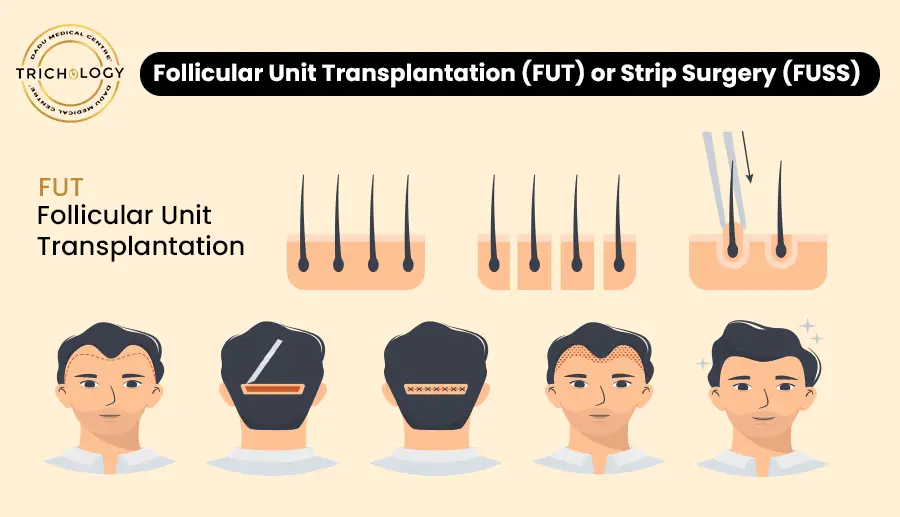
1. Follicular Unit Transplantation (FUT) or Strip Surgery (FUSS)
Follicular unit transplantation, also known as the strip method is a traditional approach to hair transplantation. In this method, a long, thin strip of hair-bearing skin is removed from the back of the scalp. Using stereo-microscopic dissection, individual follicular units are harvested from the strip and the harvested donor follicles are then implanted one by one into the micro holes created in the recipient areas of the scalp.
The primary goal of a FUT hair transplantation is to achieve maximum fullness from hair restoration. For candidates experiencing significant balding around the crown area of the head such as men with pattern baldness, FUT can be a better solution for better coverage and fullness.
The process of FUT hair transplantation is as follows:
- The hair transplant surgeon in India first re-draws the hairline and marks the area of hair extraction. The hair at the donor site, from where hair is removed must be trimmed to about two millimetres within 24 hours before the hair transplant session.
- The candidate may have an option of taking a sedative before surgery. Usually, local anaesthesia is injected or applied to the scalp to numb it so that the overall surgery is comfortable for the candidate.
- Once the donor site is numb, the surgeon cuts out the strip of skin with the hair follicles that will be used as a graft from the back of the candidate’s head.
- The harvested strip is placed under a stereo-dissecting microscope to separate the hair follicles from the skin. The harvested individual hair follicles are ready for transplantation.
- The surgeon sutures the cut made in the donor area which heals to leave a fine linear scar.
- Next, the surgeon creates micro-holes in the recipient area using a sharp surgical tool or needle. In these holes, the harvested hair grafts are inserted one by one in such a pattern that looks natural.
- After coverage of the entire bald area with donor hair grafts, the surgeon applies an antibiotic and sterile surgical dressing to the scalp.
Candidates can expect to start noticing the new hair growth at approximately 4 months after the treatment. The transplanted hair follicles continue to grow hair in the same way as the existing hair, as time passes, thus creating a fuller, thicker head of hair.
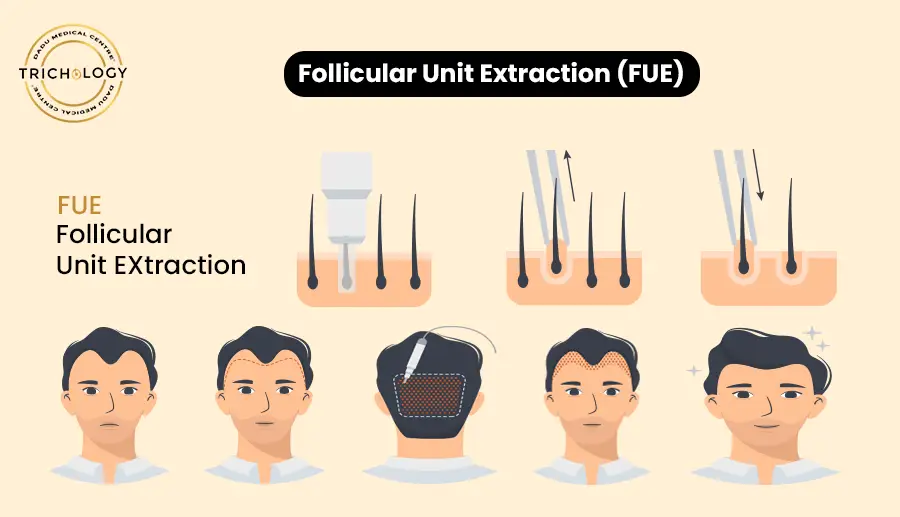
2. Follicular unit extraction (FUE)
Follicular Unit Extraction is an advanced technique of hair transplantation that propels the field of hair transplant surgery one step closer to the minimally invasive procedure.
Hair grows in groups of two to four and each group is called the follicular unit. In the FUE procedure, the whole group of a follicular unit is extracted with an automated micro-punch tool.
In this type of hair transplantation, the healthy individual hair follicles from the donor areas of the scalp are plucked out using a micro-punch device and implanted one by one directly in the holes covering the thinning or bald area of the scalp. Apart from the back of the scalp, the beard area, chest, and back can also be utilised for the extraction of individual follicles, particularly if a larger graft is needed or the donor area on the back of the scalp is relatively weak
FUE hair transplants are most commonly performed on the scalp. They can also be done anywhere on the body where hair is thin or absent such as on the beard, arms, legs, and even on genital area.
The process of FUE hair transplantation is as follows:
- Before starting with the FUE hair transplant session, the surgeon shaves down the hair in the areas to be treated, where follicles will be removed as well as around the transplant area.
- The surgeon then harvests healthy hair follicles using a micro punch tool.
- Next, the surgeon makes use of a needle or other small sharp tool to create a series of tiny incisions in the recipient areas.
- The extracted hair follicles are inserted into these incisions.
- Lastly, the surgeon cleans the operation site and covers it with a bandage.
Recovery from FUE is quick in contrast to FUT hair transplantation. The candidate may have swelling or discomfort for about 2-3 days after the treatment. The donor areas heal to leave behind not many noticeable micro-punch scars that are easily concealed with long hair.
Various other types of techniques of hair transplantation are also performed at DMC Trichology Clinic. The procedure is tailored based on one’s needs and requirements. To learn more about which technique is best for you and to learn more about the cost of the best hair transplant surgery in India, get a consultation with Dr. Nandini Dadu at DMC Trichology Clinic.
3. DMC Golden Touch®
The DMC-Golden Touch Technique represents our exclusive in-house customised treatment, meticulously designed to deliver exceptional results. This innovative procedure combines FUE extraction with advanced implantation methods using a needle or implanter, including the cutting-edge Direct Hair Implantation (DHI) technique. Both FUE and DHI are considered the most advanced versions in the field of hair restoration. What sets the DMC-Golden Touch Technique apart is its unparalleled uniqueness and the emphasis on a painless surgical experience, completely devoid of stitches. This procedure not only ensures superior outcomes but also prioritises patient comfort, making it an exceptional choice for those seeking a modern and efficient solution for hair transplantation.
Benefits DMC Golden Touch®:
- It delivers greater precision with maximum accuracy
- The patient experiences no pain or scarring
- There are no stitches involved
- No downtime, fast healing, exceptional results.
Pre-Treatment Care Instructions
Before the hair transplant session, the surgeon recommends doing the following:
- Do not smoke for at least a day or two before the surgery
- Do not drink alcohol for at least 3 days before the surgery
- Avoid taking blood thinners, and over-the-counter medications for approximately 2 weeks before the surgery.
- Do not take any dietary supplements or vitamins for 2 weeks before the surgery
- Do not take antidepressants for about 1 weeks before surgery
- Do not get your haircut before the surgery
- To increase blood flow to the scalp, do a good scalp massage for 10 to 20 minutes every day for a few weeks
- Don’t take medications such as mino-xidil, that the surgeon advised you to take.
- Stop colouring your hair two weeks before the procedure, and ensure a fresh hair wash the night before for optimal preparation.
Aftercare Instructions
Following hair transplantation, the candidate must follow these post-surgical instructions provided by the surgeon:
- Refrain from washing your hair or showering for at least 5 days after the treatment, and have your initial head wash performed by our team.
- Use gentle and scent-free shampoos for a few weeks once you start washing the hair
- To help speed up healing, take a couple of days off work
- Do not comb or brush new hair for at least 3 weeks
- Do not wear hats or other clothing that goes over the head
- Do not do any strenuous physical activity for at least 2 weeks.
- Avoid swimming for 1-2 months after the procedure.
Comments (0)
Loading comments...